
news
“You’re still the same person”: A Veteran’s Path from PTSD to Purpose — with Cory Rinaldi

Oct

Cory Rinaldi is an Australian veteran whose 20-year military career was cut short in 2015, when he was medically discharged with an unexpected diagnosis of Chronic Post-Traumatic Stress Disorder (PTSD).
Initially, Cory did not recognise the symptoms of PTSD in himself. It was another veteran who noticed his mannerisms and suggested that he seek a professional opinion.
Cory remembers that when working in the military, PTSD was treated like an infectious disease. He was reluctant to label himself with PTSD because he couldn’t pinpoint a reason to justify the diagnosis. But each night, he was dreaming of combat he hadn’t even experienced, grinding his teeth down, and leaving himself exhausted.
When his military career ended, Cory felt he hadn’t achieved what he wanted, and that he was letting down the people who expected him to succeed.
In the early days after his PTSD diagnosis, the first person who Cory told was a casual acquaintance. Once he’d revealed it to someone, he felt a weight had been lifted. He realised, “Why shouldn’t I tell people? I’ve done nothing wrong”.
Cory now understands that prolonged stress and excess adrenaline had changed how his brain was operating, but it hadn’t changed who he was.
“You join the defence force because you’re strong and determined. Your body and mind may have changed, but you’re still the same person. Just because you’ve got something like PTSD shouldn’t stop you from living a good life.”
Cory recognised that although he was facing the end of his military career, it was not the end of his life, and he knew he had to find new purpose. This was when he returned to his past love of fine arts, and he found that painting helped him feel less stuck. At first, he didn’t think anything more would become of it.
During this time, Cory was also involved with Cronulla RSL as its Subbranch President. This role connected him with fellow veterans who shared his experiences, and it was here that he realised people may be interested in seeing his artwork.
Then, thanks to his involvement in the veteran community, Cory was offered a coveted position as the inaugural artist in residence at the ANZAC Memorial. Initially he felt nervous to push himself outside of his comfort zone, but with the encouragement of his family, he accepted the opportunity.
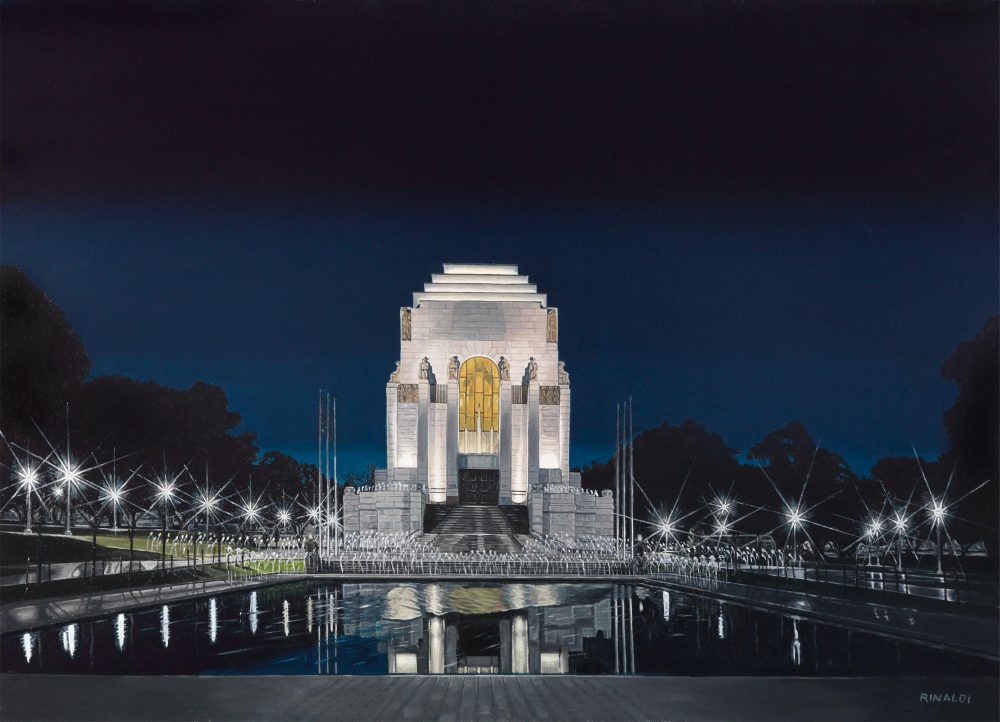
In his role as artist in residence, Cory was able to dive back into painting. The more he worked on his art, the more ideas started coming back, and Cory could see a purpose using his art to help others. People were relying on him, and although it was hard, he kept going.
As Cory developed his artwork and reflected on Australia’s broader military history, one symbol repeatedly found its way into his work: the Australian National Flag. Cory has been drawn to the powerful emotion tied to the Australian flag as both an artist and a soldier.
“Flags identify us, they are our identity. All battalions carry flags, you always have a flag. You wear a patch with the flag. We wear it, we salute it, and when our time comes, the flag embraces us like a mother.”
Cory remembers a clear moment from his time on deployment, where he found himself standing before the bare coffins of fallen soldiers, thinking: “I should have brought an Australian flag”.
When Cory began to paint from his experience, he focused on capturing emotion in the detail of a frozen moment. He didn’t realise until after finishing his piece ‘Sacrifice’ that he had been processing what he had seen as he painted. Afterwards, he found he could talk more easily about his experience.

Cory hopes that others in his position can also be affected by his art. He aims to create pieces which capture emotion, but without being painful for those who have lost people close to them. He knows how deep those emotions run: “Even if someone dies now in the Defence Force, it affects us as veterans because it brings back memories of people we’ve lost.”
Many veteran support systems do not consider artistry as a practical career path for veterans, seeing it instead as a standalone treatment or therapy. Cory is an advocate for art as a pathway to healing, purpose, and connection for veterans after service, having found new purpose in his own life through his artwork.
“I know I have inspired others, because I’ve had so many people tell me.”
To support Cory Rinaldi and see more of his inspiring work, follow @coryrinaldiart on Instagram and Facebook.
